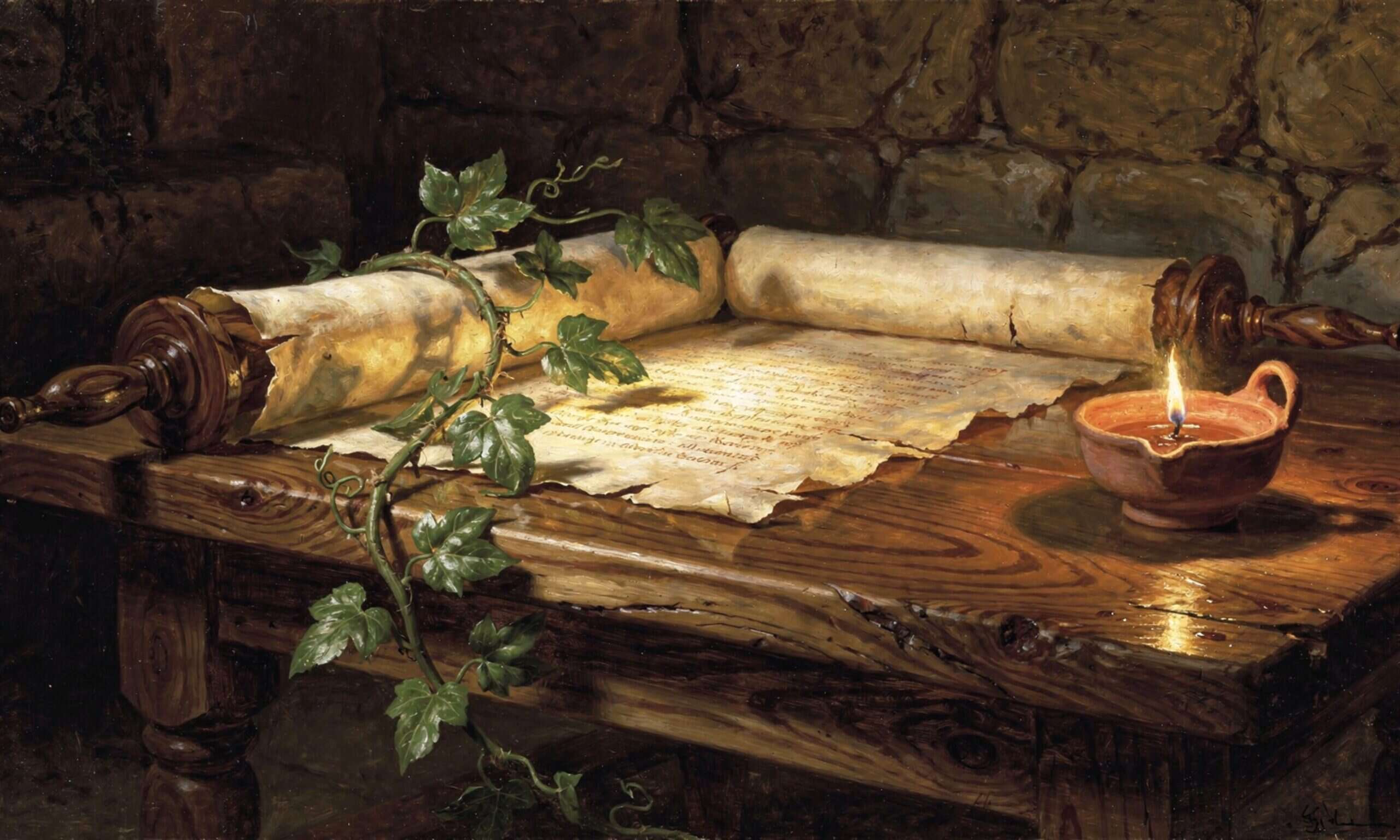
"Don't think that I came to destroy the law or the prophets. I didn't come to destroy, but to fulfil." Mattityahu 5:17 · KWS
He Came Not to Destroy
Fulfilled is not the same as cancelled.
The institutional church teaches that the Torah — the instruction of YHWH delivered through Moses — ended at the cross. Yeshua Himself says the opposite: "Most certainly, I tell you, until heaven and earth pass away, not even one smallest letter or one tiny pen stroke shall in any way pass away from the law, until all things are accomplished" Mattityahu 5:18 Heaven and earth are still here. The Torah therefore still stands.
What changed is not the mitzvot. What changed is where they live. They were written on stone at Sinai, given to a people who could not keep them, and that was by design — the stone was always pointing forward. The law carries "a shadow of the good to come, not the very image of the things" Ivrim 10:1 and a shadow is cast by something real, falling in the direction the real thing is standing. So the promise was never a different Torah but the same one moved: "I will put my laws into their mind; I will also write them on their heart" Ivrim 8:10 Stone to heart. The same instruction, a new address, and at last a heart able to hold it.
"Fulfilled" (Greek plēroō, Hebrew male) means filled full. Not emptied. Not retired. Not replaced. A cup fulfilled is a cup brim-full of what it was made to hold. Yeshua filled the Torah full — of Himself, of love, of the Father's intent — and handed it to His followers alive.
"I will put my law in their inward parts, and I will write it in their heart. I will be their Elohim, and they shall be my people." Yirmeyahu 31:33 · KWS
Written on the Heart
The new covenant is not a new law. It is the old law in a new place.
Read Yirmeyahu 31:31–34 carefully. When YHWH promises a new covenant, He does not promise a new set of mitzvot. He says He will take the same Torah and write it somewhere new — "in their inward parts… in their heart." The mitzvah to love Him with everything, to keep Shabbat, to speak truth, to not steal, to not kill in heart or hand — same mitzvot. New location. Inside.
Yechezkel says it in parallel: "I will put a new spirit within you. I will take away the stony heart out of your flesh, and I will give you a heart of flesh. I will put my Ruach within you, and cause you to walk in my statutes. You shall keep my ordinances and do them" Yechezkel 36:26–27 Cause you to walk. Not command and leave you to your weakness. Cause. Enable. From within.
This is why Yeshua can summarise the entire Torah in two mitzvot — love YHWH with all, love your neighbour as yourself Mattityahu 22:37–40 — and not be softening anything. Every specific mitzvah is an expression of those two. Write love on the heart, and the mitzvot follow from the inside.
"If you love me, keep my mitzvot." Yochanan 14:15 · KWS
Love Is the Keeping
Not legalism. Not cheap grace. Love expressed as obedience.
There are two ditches on either side of The Way. One ditch is legalism: counting the rules, keeping them to earn favour, feeling righteous about the count. Pharisees Yeshua rebuked fell here — kept the letter and missed the heart, tithed the mint and skipped the justice Mattityahu 23:23.
The other ditch is cheap grace: the prayer was said, the box is ticked, and how a life is lived no longer matters because Yeshua paid for it. Yeshua closed that ditch Himself, and He closed it using the very words people expect to be enough: "Not everyone who says to me, ‘Adonai, Adonai,’ will enter into the Kingdom of Heaven, but he who does the will of my Father who is in heaven" Mattityahu 7:21 Saying the name is not the same as doing the will. He was not describing outsiders there — He was describing people certain they were already in.
Both ditches are pits. The road between them is love expressed as obedience. "One who has my mitzvot and keeps them, that person is one who loves me" Yochanan 14:21 Not "keeps them to earn love" — that is legalism. Not "is loved without keeping them" — that is the lie. But: the one who loves Him is recognisable because he keeps His. Love is the fuel. Obedience is the motion.
And what He commands is not heavy — "my yoke is easy, and my burden is light" Mattityahu 11:30 grievous only to the flesh that wants its own way, light to the heart that has been born again.
"If you keep my mitzvot, you will remain in my love, even as I have kept my Father’s mitzvot and remain in his love." Yochanan 15:10 · KWS
Why Love Grows Cold
Not the laws of a nation. The Father’s Torah, and Yeshua’s mitzvot.
Speaking of the days before His return, Yeshua named a cause and its effect: "Because iniquity will be multiplied, the love of many will grow cold" Mattityahu 24:12 The word behind iniquity is anomia — literally without law. It is usually heard as crime and disorder, a society slipping out of the hands of its government. Yeshua was not talking about the laws of any nation. He was talking about His Father’s Torah and His own mitzvot.
He used the same word for people who called Him Adonai and did mighty works in His name: Depart from me, you who work iniquity Mattityahu 7:23 — workers of anomia, living as if the Father had never commanded anything. And He had already said what every command rests on: love Adonai with all the heart, soul and mind, and love your neighbour as yourself. The whole law and the prophets depend on these two mitzvot Mattityahu 22:40.
So the two cannot be pulled apart. The mitzvot are the shape love takes — towards Adonai and towards one another. Set them aside and the love goes with them. The keeping does not stop because love grew cold. Love grows cold because the keeping stopped. And it grows cold between people first: in the verses just before, many will deliver up one another, and will hate one another Mattityahu 24:10.
The way back is the road that was left. Return to His mitzvot, and the love returns with them — But he who endures to the end will be saved Mattityahu 24:13.
"I will put my Ruach within you, and cause you to walk in my statutes." Yechezkel 36:27 · KWS
The Ruach HaKodesh — How the Walking Becomes Possible
Not a force. A Person. And a gift on the far side of surrender.
Everything the Father asks is beyond the flesh. To love Him with all, to love your neighbour as yourself, to forgive as you have been forgiven, to keep Shabbat, to walk the moedim, to put off anger and malice and lying and lust — none of that is manageable on willpower. Israel tried under the old covenant and could not. His followers tried and could not. The stone heart cannot keep a written law; it breaks the law and itself.
So He gave the Ruach HaKodesh — His own Ruach — to live inside those who have surrendered to Yeshua. Not as a decoration on a half-given life. As the very thing that enables obedience. Yeshua named the order Himself: "If you love me, keep my mitzvot. I will pray to the Father, and he will give you another Counsellor, that he may be with you forever" Yochanan 14:15–16 and He said where that Counsellor would end up — "he lives with you and will be in you" Yochanan 14:17. Love first, then the mitzvot, then the One who stays. Once He is in, He produces the obedience He asks for.
What He produces is fruit, and fruit is not a list to be white-knuckled. "I am the vine. You are the branches. He who remains in me and I in him bears much fruit, for apart from me you can do nothing" Yochanan 15:5 Yeshua put it the other way round as well, and that settles the order for good: "every good tree produces good fruit" Mattityahu 7:17. The fruit does not make the tree good; the tree makes the fruit good. If the tree is not planted, no amount of trying produces fruit. If the tree is planted, fruit comes in season.
And if He is not in you at all, there is nothing there to bear. "unless one is born of water and Ruach, he can’t enter into Elohim’s Kingdom" Yochanan 3:5 No one follows The Way without the Ruach. There is no Ruach without surrender. There is no surrender without letting go of what you are clinging to — the vice, the relationship, the possession, the identity, the pride. Let it all go. Then He comes.
"Beware of false prophets, who come to you in sheep's clothing, but inwardly are ravening wolves. By their fruits you will know them." Mattityahu 7:15–16 · KWS
Test the Spirits — The Ruach Never Contradicts the Word
The Ruach who inspired Scripture does not speak against Scripture.
People will claim the Ruach told them things, and there has always been a counter-kingdom that speaks too. Yeshua named its voice without softening it: "When he speaks a lie, he speaks on his own; for he is a liar, and the father of lies" Yochanan 8:44 and Hitgalut names him "the deceiver of the whole world" Hitgalut 12:9 A voice is not from the Father because it is loud, or moving, or arrives carrying certainty. So the Word gives a test with two edges:
1. Does it line up with the written Word? "Turn to the law and to the covenant! If they don't speak according to this word, surely there is no morning for them" Yeshayahu 8:20 If the "leading" contradicts what He has already said — about marriage, about truthfulness, about forgiveness, about the mitzvot — it is not Him. The Ruach inspired Scripture. He does not now speak against what He inspired.
2. Does it line up with Yeshua's character and teaching? "He will glorify me, for he will take from what is mine and will declare it to you" Yochanan 16:14 The Ruach points to Yeshua, speaks in Yeshua's tone, honours Yeshua's mitzvot. Anything calling itself "the Ruach" that does not glorify Yeshua, does not sound like Yeshua, does not obey Yeshua — is not Him.
This is the answer to the common distortion: "the Ruach told them to leave a spouse / ignore the mitzvah / do what feels right even though it breaks Scripture." The Ruach did not say any of that. Something else did, and it borrowed His name. Test every leading against the Word and against the Mashiach. If it fails either test, throw it out.
The same test exposes the gift market. Yeshua sent the twelve with one rule about the economics of His authority — "freely you received, freely give" Mattityahu 10:8. The instant a "gift" is monetised, ticketed, televised, it has been severed from its source. Whatever He still chooses to do in His sovereignty is His to do, freely, without a platform. Whoever is selling it is not sent.
"Heaven and earth will pass away, but my words will not pass away." Mattityahu 24:35 · KWS
Walk
The mitzvot are not gone. They are inside you. Walk.
If you have surrendered to Yeshua, the Torah is no longer a mountain you stand at the foot of. It is written on your heart, and the Ruach is in you, and the walking is possible now in a way it was never possible under Sinai alone.
Open the Word. Read it slowly, one chapter at a time. When it convicts you, let it. When it comforts you, rest. When it tells you to stop something, stop. When it tells you to start something — love, forgive, keep Shabbat, speak truth, give freely — start. He will help you. He is in you for that exact purpose.
This is The Way: Torah not abolished, Torah fulfilled, Torah alive in Yeshua, Torah written on the heart, Torah kept by the Ruach from the inside out — love, expressed as obedience, enabled by His presence. Walk.