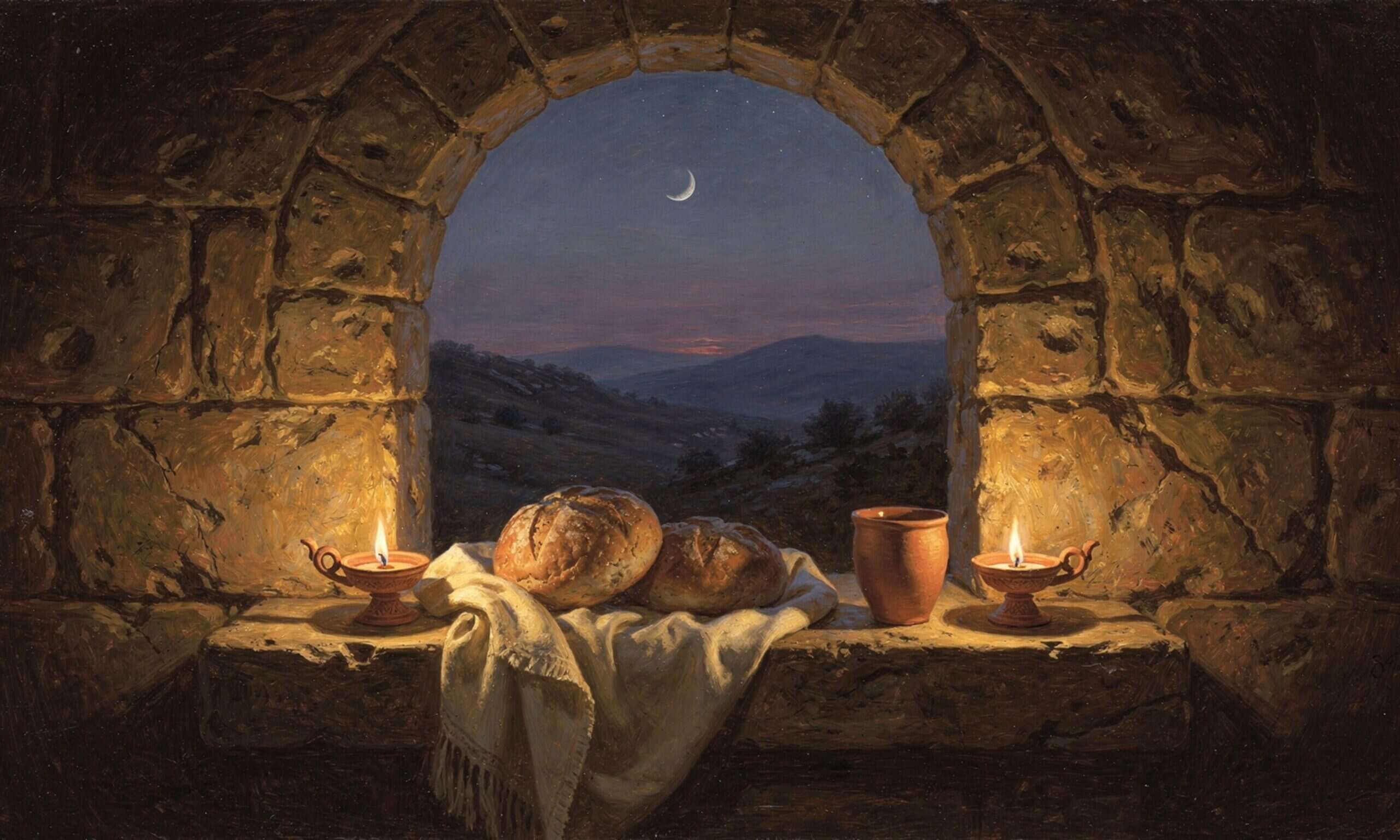
"Remember the Shabbat day, to keep it kodesh." Shemot 20:8 · KWS
Before Time Bent
He rested first. Then He commanded.
Shabbat did not begin at Sinai. It began at the end of the sixth day, when the work of creation was finished and the Creator stopped. "Elohim blessed the seventh day, and made it kodesh, because he rested in it from all his work of creation which he had done" Bereshit 2:3 Before Israel was a nation, before Moses was born, before the tablets — the seventh day was blessed and set apart.
The Hebrew word kodesh means set apart, distinct, reserved. It is the word from which this ministry takes its name — and it is the very word YHWH used over the seventh day. When He made the seventh day kodesh, He reserved it — separated it from the other six, handed it to creation as a sign, and kept it Himself. Shabbat is not a Yehudi custom. It is a pattern written into the universe by its Maker. The week itself — seven days, one rhythm — is His signature on time. The institutional church treats Shabbat as something that belonged to one people and was replaced. It belonged to the Father before there was a people, and He did not replace it. He kept it.
"It is a sign between me and the children of Israel forever; for in six days YHWH made heaven and earth, and on the seventh day he rested, and was refreshed." Shemot 31:17 · KWS
Written in Stone by His Own Finger
Fourth of ten. Not optional.
When YHWH gave the mitzvot at Sinai, He did not dictate them to Moses. He wrote them Himself. "The tablets were the work of Elohim, and the writing was the writing of Elohim, engraved on the tablets" Shemot 32:16 Ten mitzvot. His own handwriting. In stone — the most permanent medium the ancient world knew.
The fourth is Shabbat:
"Remember the Shabbat day, to keep it kodesh… for in six days YHWH made heaven and earth, the sea, and all that is in them, and rested the seventh day; therefore YHWH blessed the Shabbat day, and made it kodesh" Shemot 20:8–11
The reason He gives for keeping Shabbat is that He kept it. Not because of Israel. Not because of deliverance from Egypt — that reason is added in Devarim 5, alongside creation, not in place of it. The primary reason is that YHWH rested, and rest is His gift to His creation. To move the day is to call His handwriting wrong.
"There was evening and there was morning, the first day." Bereshit 1:5 · KWS
Evening to Morning, Not Morning to Evening
The day begins when the sun sets.
Seven times in Bereshit 1 the pattern is repeated: evening and morning. Not morning and evening. The set-apart day begins at sundown and ends at the next sundown. This is why Shabbat runs Friday sundown to Saturday sundown — not midnight to midnight, not sunrise to sunrise.
Every moed He commanded follows this pattern. Yom Kippur: "from evening to evening, you shall keep your Shabbat" Vayikra 23:32 Pesach the same — fourteenth day of the month, evening to evening Shemot 12:18. His calendar is not the world's calendar. His clock is not the world's clock.
When a visitor comes to the site at dusk on Friday, they are already inside Shabbat. When the sun sets on Saturday evening, Shabbat is over — not at midnight, not at sunrise Sunday. The Word measures days the way He measured them at creation.
"He is not here, for he has risen, just like he said. Come, see the place where Adonai was lying." Mattityahu 28:6 · KWS
The Resurrection Was Saturday
Firstfruits, not Sunday. Yeshua, not Easter.
The institutional church teaches that Yeshua rose on Sunday, and therefore Sunday replaced Shabbat as the "Lord's day." Read the text carefully. Every Gospel says the women came to the tomb at the end of the Shabbat, as it began to dawn towards the first day — and found it already empty Mattityahu 28:1; Yochanan 20:1. The stone was rolled away before they arrived. The resurrection had already happened.
When did it happen? On Firstfruits — the moed commanded in Vayikra 23:10–11, the day the first sheaf of the barley harvest was waved before YHWH, which falls the day after the Shabbat during Unleavened Bread. In that Pesach week Firstfruits began at sundown on the seventh day, and Yeshua rose inside that window. Hitgalut names Him by exactly that harvest title: "the firstborn of the dead, and the ruler of the kings of the earth" Hitgalut 1:5 First sheaf of a harvest still coming in.
Easter is the institutional rebrand — untethered from YHWH's calendar at Nicaea and renamed for a Germanic dawn goddess (Ēastre). The full account is on Pesach.
"You have made the mitzvah of Elohim void because of your tradition." Mattityahu 15:6 · KWS
Laodicea 364 CE — The Day They Moved Shabbat
Name the council. Name the canon. Name the price.
By the fourth century the institutional church — now under imperial patronage — convened at Laodicea and issued Canon 29:
"Christians must not judaize by resting on the Shabbat, but must work on that day, rather honouring the Lord's day by resting, if possible, as Christians. However, if any shall be found to be judaizers, let them be anathema from Christ." — Council of Laodicea, Canon 29, 364 CE
Read that again. The very people who followed Yeshua's own pattern of Shabbat rest — the pattern He never abolished, the pattern the first-century assemblies kept — were declared cut off from the Mashiach by a council of bishops. Shabbat was called judaizing. Sunday — dies Solis, the day of the sun god — was mandated in its place.
Constantine had already prepared the ground in 321 CE, decreeing: "On the venerable day of the Sun let the magistrates and people residing in cities rest, and let all workshops be closed." The venerable day of the Sun. Not the seventh day of YHWH. Not the day He sanctified. The day of Sol Invictus, the imperial solar deity. Laodicea finished what Constantine started: made Sunday mandatory, made Shabbat punishable.
Every branch of Christendom that came after inherited it. The Reformers broke with the pope over indulgences and justification but not over the day; they kept the stolen day and the stolen feast. "You have made the mitzvah of Elohim void because of your tradition" Mattityahu 15:6 is not a rebuke only for Pharisees. It fits exactly.
"For the Ben Adam is Adonai of the Shabbat." Mattityahu 12:8 · KWS
Come Back In
Not a burden. A gift. The one He kept.
Yeshua never broke Shabbat. He corrected how the rabbis of His day were fencing it with human rules and making it a burden. Healing on Shabbat, pulling a sheep out of a pit on Shabbat, plucking grain when hungry on Shabbat — none of that violated the mitzvah. Adding hundreds of sub-rules that YHWH never gave, and then condemning people for breaking the sub-rules, did.
Ivrim puts it plainly: "There remains therefore a Shabbat rest for the people of Elohim" Ivrim 4:9 The rest remains. It is the seventh day, from evening to evening, and it is waiting for whoever will come back in.
The day itself He kept, and the day itself He called His own — Adonai of the Shabbat Mattityahu 12:8. A thing you are Adonai of is a thing you keep, not a thing you discard. And the rest He offers begins in Him before it is ever a day on a calendar: "Come to me, all you who labour and are heavily burdened, and I will give you rest" Mattityahu 11:28 Rest in the Person, then rest on the day He set apart for it. The two were never rivals.
Start this Friday at sundown. Close the work, open the Word. The Father has been keeping this day waiting.