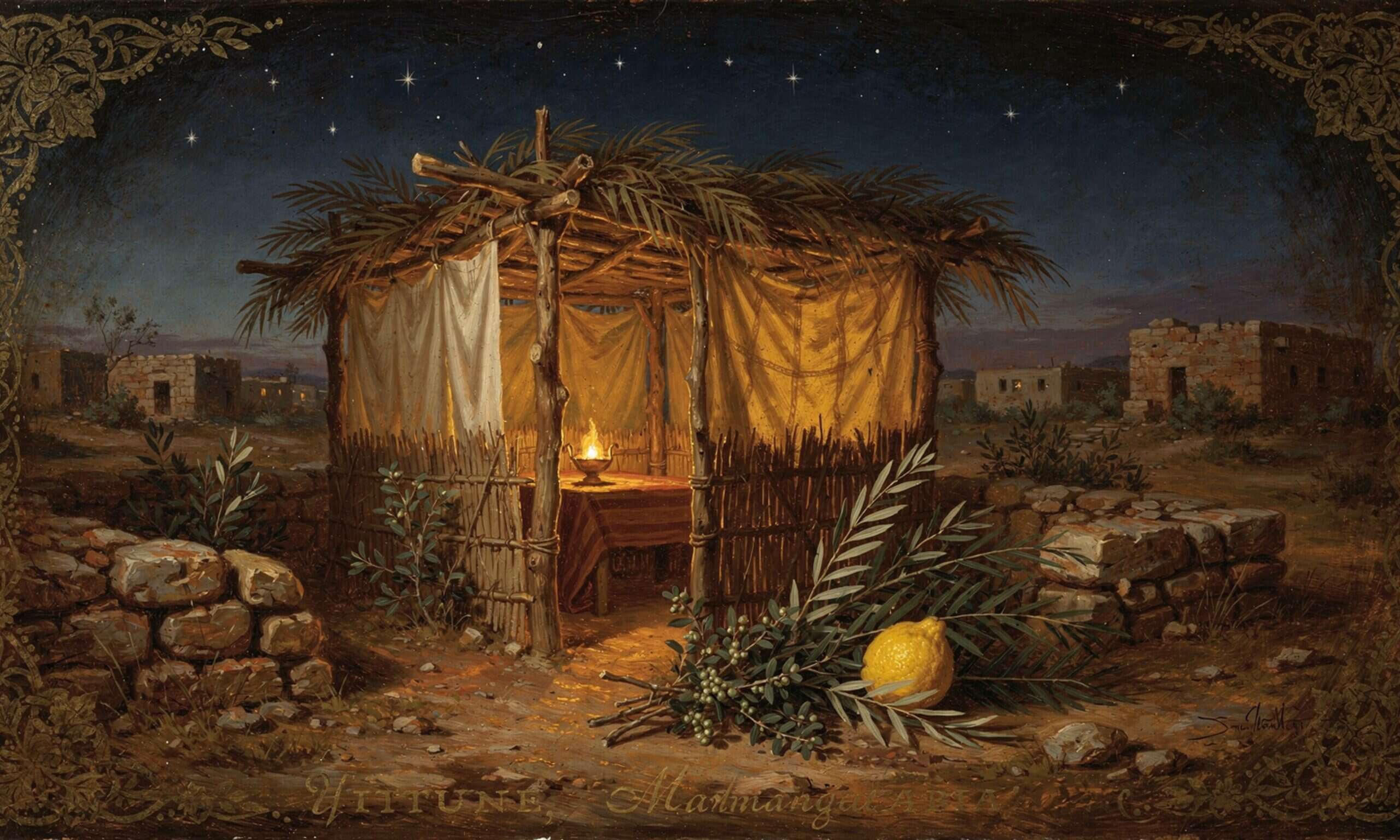
"On the fifteenth day of this seventh month is the Chag HaSukkot for seven days to YHWH. You shall dwell in temporary shelters for seven days. All who are native-born in Israel shall dwell in temporary shelters, that your generations may know that I made the children of Israel to dwell in temporary shelters when I brought them out of the land of Egypt." Vayikra 23:34, 42–43 · KWS
The Torah Mitzvah
The fifteenth of the seventh month. Seven days. In a booth.
Sukkot starts five days after Yom Kippur. For seven days, the household lives in a sukkah — a temporary shelter built outdoors, with a roof of branches loose enough to see the stars through. The first day is a kodesh convocation. An eighth day, called Shemini Atzeret, follows as a separate kodesh convocation Vayikra 23:36.
It is the most physical of the moedim. You build the booth with your hands, you eat in it, you sleep in it. You experience, in your body, the fragility of dwelling — and the faithfulness of the Elohim who covers the fragile.
"Rejoice before YHWH your Elohim seven days." Vayikra 23:40 · KWS
The Scripture Observance
Build it. Live in it. Rejoice in it.
Sukkot is also called z'man simchatenu — "the season of rejoicing." Torah commands rejoicing Vayikra 23:40, Devarim 16:14–15. Israel takes the four species — palm, willow, myrtle, and citron — and waves them in all directions, declaring YHWH's presence over the whole earth.
The autumn harvest is in. The work of the year is finished. The household sits under the open sky and remembers: Israel were strangers in Egypt, sheltered by His cloud through the wilderness, and followers of The Way are still strangers in this world — sheltered by Him.
"The Word became flesh and lived amongst us. We saw his glory, such glory as of the only born Son of the Father, full of grace and truth." Yochanan 1:14 · KWS
Yeshua in Sukkot
He tabernacled. Likely on Sukkot itself.
The Greek word in Yochanan 1:14 — eskēnōsen — literally means pitched His tent / set up His sukkah. John, writing decades after the events, chose that word deliberately. The eternal Word became flesh and built a sukkah of human body to dwell among humanity — temporarily, fragilely, on this earth.
If this is right, Yeshua's first physical act on earth was to keep Sukkot — to be born into the very moed that means Elohim dwelling temporarily with His people. He came as the fulfilment of His own appointed time.
"Behold, Elohim's dwelling is with people; and he will dwell with them, and they will be his people, and Elohim himself will be with them as their Elohim." Hitgalut 21:3 · KWS
The Final Sukkot
He will keep this moed with His people forever.
The end of the story circles back to this moed. Hitgalut 21 — the new heavens and new earth — describes what is essentially an eternal Sukkot: Elohim dwelling (tabernacling) with people, no veil between them, no temple needed because "Adonai Elohim the El Shaddai and the Lamb are its temple" Hitgalut 21:22 The first physical act on earth (the sukkah of flesh) and the final state of all things (the eternal dwelling) frame the whole ministry of Yeshua. Sukkot is the bookends.
Zechariah the prophet says all nations who survive the day of judgement will keep Sukkot — and that's the only feast he names: "Everyone who is left of all the nations that came against Jerusalem will go up from year to year to worship the King, YHWH Tzeva'ot, and to keep the Chag HaSukkot" Zecharyah 14:16 This moed outlasts every empire.
What the Institutional Church Did
Christmas in winter. Sukkot forgotten.
The institutional church moved the celebration of Yeshua's birth to December 25 in the fourth century — adopting the Roman feast of Sol Invictus (the Unconquered Sun) and rebranding it. The actual moed He likely was born on, the moed that means Elohim dwelling among humanity, was buried under wreaths and trees and carols about a winter that was not when He came.