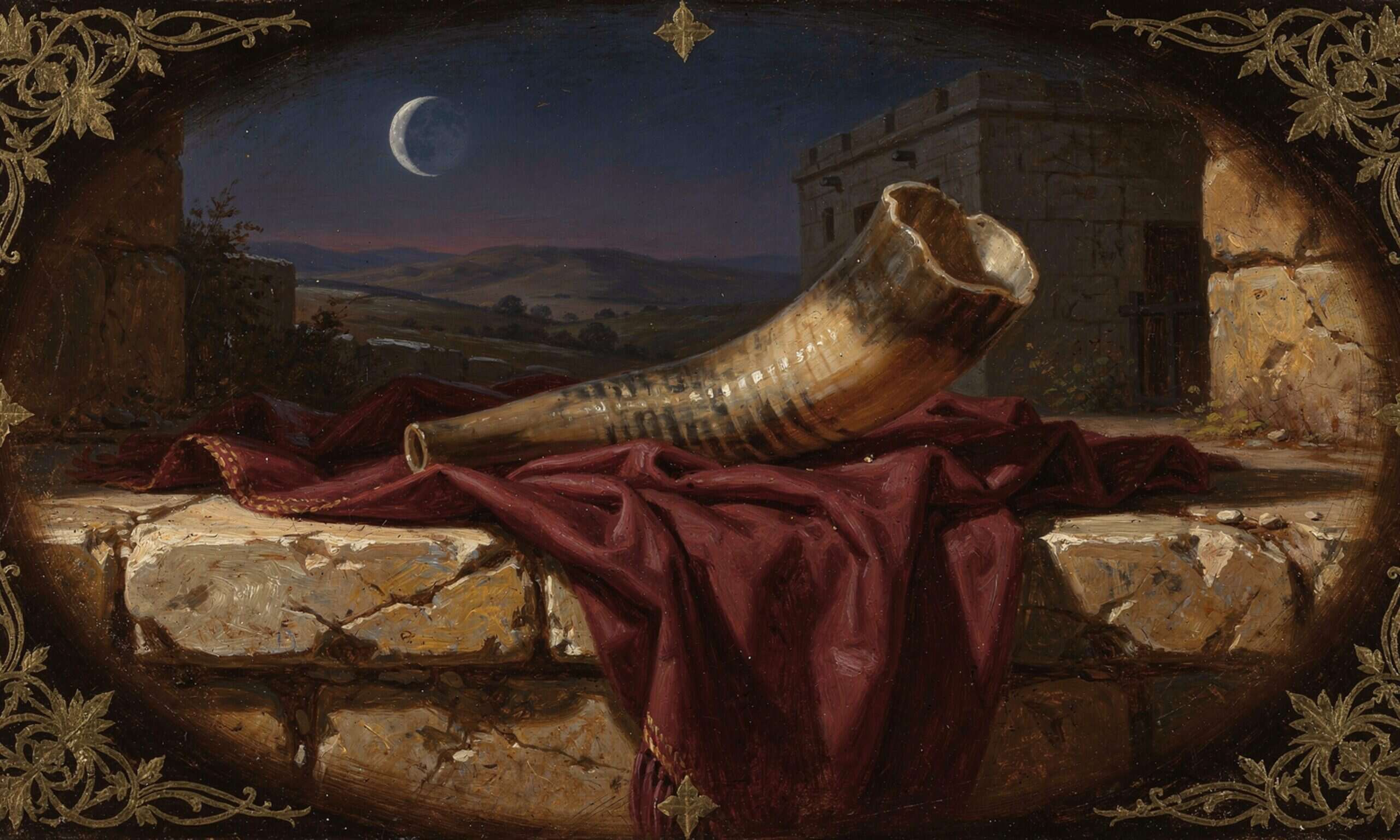
"In the seventh month, on the first day of the month, there shall be a solemn rest for you, a memorial of Yom Teruah, a kodesh convocation. You shall do no regular work. You shall offer an offering made by fire to YHWH." Vayikra 23:24–25 · KWS
The Torah Mitzvah
The first of the seventh month. A day of blasts.
Yom Teruah opens the seventh month — the month containing Yom Kippur and Sukkot — with one assigned act: teruah, the blast of the trumpet. The shofar (ram's horn) is sounded across the day. No regular work. The household gathers.
Later tradition came to call this day Rosh Hashanah ("head of the year") and treat it as a civil new year, but Torah does not name it that. Torah's own first month is in the spring Shemot 12:2. Yom Teruah is the first of the seventh month — a wake-up call ten days before the holiest day of the year.
The Scripture Observance
The shofar as alarm.
The trumpet in Scripture has always been an alarm. It called Israel to assemble Bamidbar 10:1–10, sounded the war-alarm in His kodesh mountain Yoel 2:1, and announced the presence of the King. On Yom Teruah, the shofar sounds and the household stops to listen.
It is also a hinge. From Yom Teruah to Yom Kippur is a ten-day window — the days of awe — when traditional Yehudi practice is to examine the heart, repair what is broken with neighbours, and prepare for the Yom Kippur. The shofar opens that window.
Yeshua in Yom Teruah
The trumpet that has not yet sounded.
The first four moedim — Pesach, Unleavened Bread, Firstfruits, Shavuot — were fulfilled in Yeshua's first coming, on the very days they fell. The Lamb died on Pesach. The Bread without leaven lay in the tomb during Unleavened Bread. He rose on Firstfruits. The Ruach fell on Shavuot. Pattern locked.
The first four moedim He fulfilled on the day. The remaining three — including the trumpet — will be fulfilled the same way. Watch the day. Listen for the blast.
What the Institutional Church Did
Replaced it with nothing.
The church has no equivalent. Yom Teruah was simply dropped. A billion who claim His name have no idea YHWH marked a day on His calendar specifically as a trumpet day — and that the trumpet of the Mashiach's return is the fulfilment that day was waiting for. The shofar fell silent in the institutional church; it has not stopped sounding among those who keep His moedim.