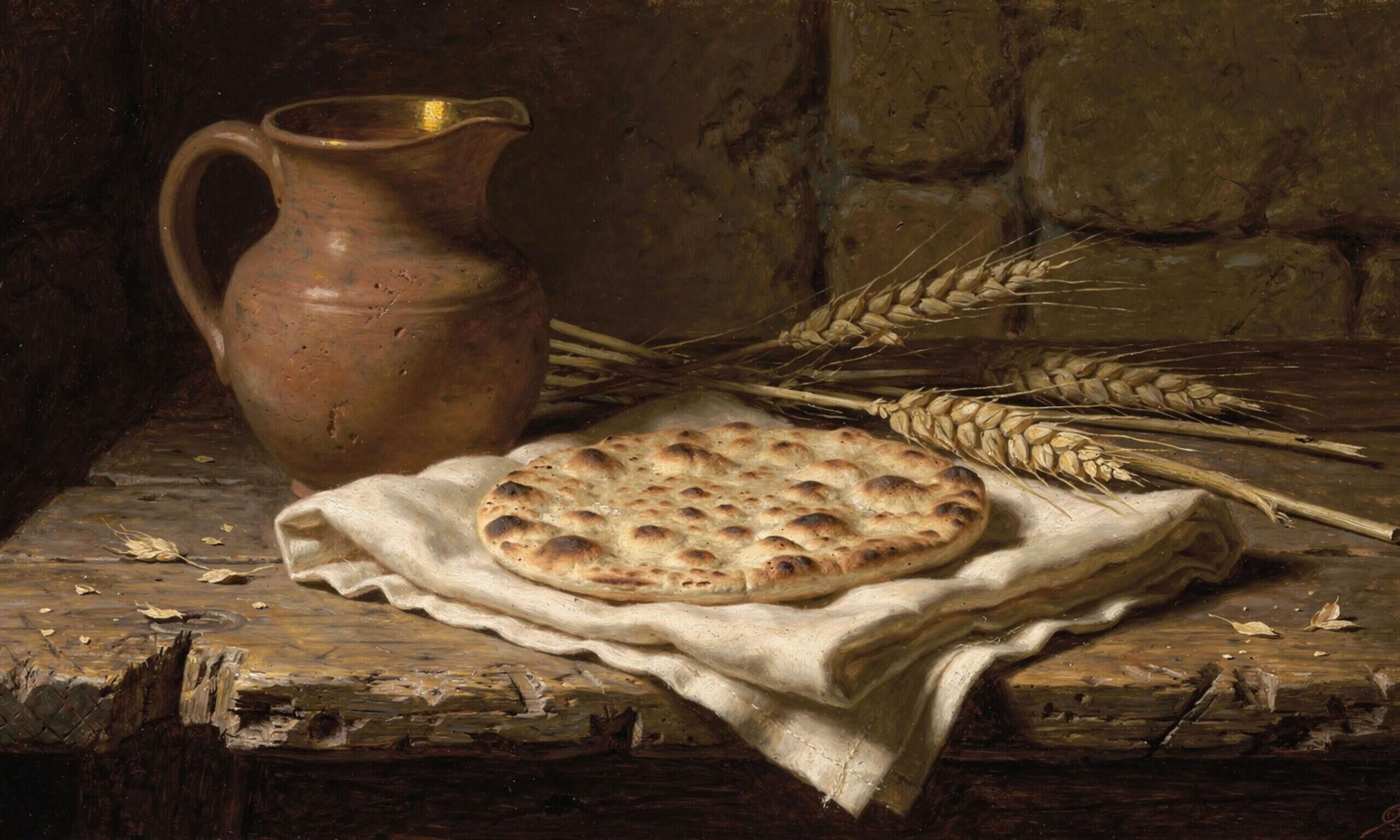
"On the fifteenth day of the same month is the Chag HaMatzot to YHWH. Seven days you shall eat unleavened bread." Vayikra 23:6 · KWS
The Torah Mitzvah
The fifteenth through the twenty-first of the first month.
Immediately after Pesach, the seven-day Chag HaMatzot begins Vayikra 23:6–8. For one week, no leaven (chametz) is to be in the house. The first day and the seventh day are kodesh convocations — work-rest days. "Whoever eats that which is leavened, that soul shall be cut off from the congregation of Israel" Shemot 12:19 The instruction is severe because the symbolism is total.
"Take heed and beware of the yeast of the Pharisees and Sadducees." Mattityahu 16:6 · KWS
The Scripture Observance
Search the house. Burn the leaven. Eat the matzah.
Leaven (yeast, sourdough, anything that puffs up grain) is removed from the household before the feast begins. The traditional bedikat chametz — a candle-lit search through every cabinet and crevice — preserves a posture: the cleansing has to be deliberate, room by room, hidden corner by hidden corner.
The matzah eaten through the seven days is "the bread of affliction" Devarim 16:3 — flat, hurried, ungilded — eaten in remembrance of leaving Egypt with no time for the dough to rise. Bread under pressure, bread of urgency, bread of deliverance.
"I am the bread of life. Whoever comes to me will not be hungry, and whoever believes in me will never be thirsty." Yochanan 6:35 · KWS
Yeshua in the Feast
The Bread of Life. The body without leaven. The unbroken Lamb.
Yeshua took the household picture and named what it stands for. When He warned the talmidim about yeast they thought He meant bread, and He corrected them: "they understood that he didn't tell them to beware of the yeast of bread, but of the teaching of the Pharisees and Sadducees" Mattityahu 16:12 Leaven is the small thing that is never content to stay small. A little of it works quietly through the whole batch and changes what the whole batch is. That is why the instruction is to remove it rather than manage it, and why the search runs through every room.
He is the one loaf in the house with nothing working through it. "one who has been in all points tempted like we are, yet without sin" Ivrim 4:15 Tested at every point the rest are tested, and nothing rose in Him. Yeshayahu had said the same of Him centuries earlier — "he had done no violence, nor was any deceit in his mouth" Yeshayahu 53:9. His body lay in the tomb through these seven days, and even there the picture held: "neither will you allow your kodesh one to see corruption" Tehillim 16:10 Unleavened in life, unleavened in death — no decay in the body, no corruption in the man.
So the matzah is not a symbol He borrowed. It is the bread He picked up and named. He took it, gave thanks for it, broke it, and handed it round: "Take, eat; this is my body" Mattityahu 26:26 Flat, striped from the oven, pierced, broken — the bread of affliction, handed round as His own body on the night before He was afflicted. "the bread which I will give for the life of the world is my flesh" Yochanan 6:51 Eat it through these seven days remembering whose body it pictures.
"Christmas" is not commanded here. December 25 is not commanded anywhere.
What the Institutional Church Did
Lent for forty days; Unleavened Bread for none.
The institutional church kept neither the seven days of Unleavened Bread nor the Pesach. In their place it built Lent — a forty-day pre-Easter period of fasting and abstinence with no command in Scripture, on a date untethered from YHWH's calendar. The matzah was replaced with leavened communion wafers, breaking the very symbolism Yeshua intended His meal to preserve.